Saturday, July 30, 2016

Of Rocks and Men

Mt. Rainier from Skyline Trail, Paradise Visitor Center
"What are men to rocks and mountains?" 
Pride and Prejudice chapter 27

Funny how the minds of Jane Austen fans can work in the same directions.

Recently, Sara Emsley posted a nice blog entitle "What are Men to Rocks and Mountains" with some great pictures from Alberta, Canada. Clearly, she was inspired by the scenery to think about the quote from Pride and Prejudice. I had the same experience hiking on Mt. Rainier near Seattle, Washington last week. As I looked over the rocky snow-draped mountain and the glacier-strewn boulders I, too, couldn’t help but think of Jane Austen’s words.

“No scheme could have been more agreeable to Elizabeth, and her acceptance of the invitation was most ready and grateful. "My dear, dear aunt," she rapturously cried, "what delight! what felicity! You give me fresh life and vigour. Adieu to disappointment and spleen. What are men to rocks and mountains? Oh! what hours of transport we shall spend! And when we do return, it shall not be like other travellers, without being able to give one accurate idea of any thing. We will know where we have gone -- we will recollect what we have seen. Lakes, mountains, and rivers shall not be jumbled together in our imaginations; nor, when we attempt to describe any particular scene, will we begin quarrelling about its relative situation. Let our first effusions be less insupportable than those of the generality of travellers." Pride and Prejudice chapter 27

Elizabeth Bennet speaks these words at a particularly difficult time. Her best friend Charlotte has just married a man Elizabeth feels is ridiculous. Mr. Bingley has just jilted her favorite sister.  She has finally been rid of the proud Mr. Darcy, who had the nerve to find her to be just “tolerable”. Finally, she has recently learned that her friend Mr. Wickham has withdrawn his preference toward her in favor of an heiress, although Elizabeth is kinder toward Mr. Wickham than she is toward Mr. Bingley.

In he midst of the gloom, Elizabeth is invited on a summer tour with her Aunt and Uncle Gardiner. Surely the opportunity to find some certainty in her life leads her to welcome such a trip.

But it is not to be. While her perceptions of rocks and mountains may be fixed, Elizabeth Bennet will return from the trip with every perception of the men in the story overturned. She will come to question and finally fully reverse her perceptions of Mr. Darcy and Mr. Wickham. As she tells Jane:

"You never will be able to make both of them good for any thing. Take your choice, but you must be satisfied with only one. There is but such a quantity of merit between them; just enough to make one good sort of man; and of late it has been shifting about pretty much. For my part, I am inclined to believe it all Mr. Darcy's, but you shall do as you chuse." Pride and Prejudice chapter 40

Elizabeth’s vision of rocks and mountains may not shift, but her perception of Mr. Darcy and Mr. Wickham certainly does. Sometimes when we search for certainty, it’s just not there, but the rocks and mountains are still awe-inspiring.

Here’s the view on Mt. Rainier.

The rocks: Nisqually Creek with cloud-shrouded Mt. Rainier behind
The mountains: Tatoosh Range from Paradise Visitor Center
Narada Falls on the road to Mt. Rainier
Mountain stream, Skyline Trail, Paradise Visitor Center
Sub-alpine meadow


Old growth forest at the base of Mt. Rainier

Friday, June 3, 2016

Mail Call: Epistolary Novels

Love and Friendship: The Poster

By Source, Fair use, https://en.wikipedia.org/w/index.php?curid=49201388

“I congratulate you and Mr. Vernon on being about to receive into your family the most accomplished coquette in England."
Lady Susan Letter IV, Mr. De Courcy to Mrs. Vernon

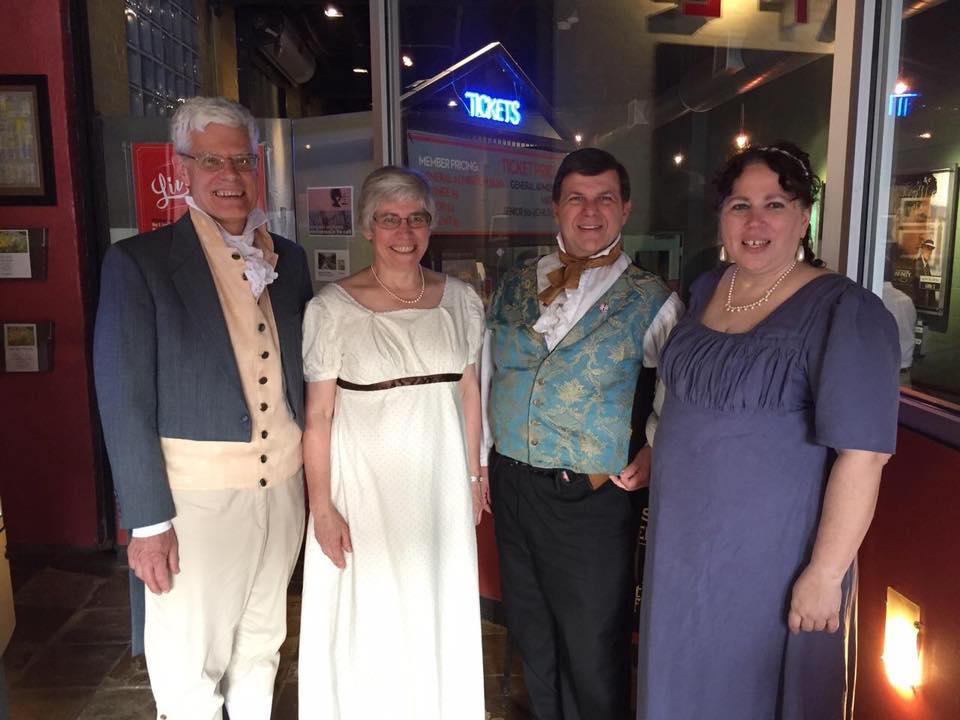
Last week, several local Janeites had the opportunity to see Love and Friendship at the Little Theater. Love and Friendship is, of course, Whit Stillman’s adaptation of Jane Austen’s Lady Susan. As several of us went in Regency dress, the occasion was a gala affair, although I am still bemused by how little note arises when half a dozen people in Regency garb appear in a Rochester restaurant or coffee shop.

JASNA and Friends attend Love and Friendship at the Little Theater.

No movie can ever be perfect Austen, but Love and Friendship comes close. Kate Beckinsale delightfully captures the deliciously despicable character of Lady Susan while Chloe Sevigny is the perfect ally as Alicia Johnson, Lady Susan’s equally scheming friend. On one occasion, as the two friends meet and discuss their difficulties with the men in their lives, Lady Susan describes Alicia's poor choice of a husband as “too old to be governed and too young to die.” The actual quote from one of Lady Susan’s letters to Alicia is:

“My dear Alicia, of what a mistake were you guilty in marrying a man of his age! just old enough to be formal, ungovernable, and to have the gout; too old to be agreeable, too young to die” Lady Susan letter 29, Lady Susan Vernon to Mrs. Johnson.

Close enough!

One of the obvious problems Stillman has with Lady Susan is in converting a novel that consists entirely of letters into a series of movie sequences. In some ways Jane Austen faced a similar problem. It is widely believed that Jane Austen originally wrote Sense and Sensibility as an epistolary novel. Many believe Pride and Prejudice also originated this way. Both novels would have needed major revisions to reach their final form.

As is well known, there are no drafts of Austen’s early work on these novels, and the evidence for the epistolary origins of both novels must come from evidence internal to the novels. The best review of this evidence I have found is an article in Persuasions by Deborah Knuth Klenck entitled "Fun and Speculation: Sense and Sensibility and Pride and Prejudice as Revisions" (1). The article is fun, and the author readily admits that everything about early versions of these novels must be speculation. Three examples from the article will serve to demonstrate the kind of evidence available to suggest an epistolary origin.

First, Knuth Klenck notes that the narrator often summarizes letters such as this letter from Sir John Middleton offering his cottage to the Dashwoods:

"The letter was . . . written in the true spirit of friendly accommodation. He understood that she was in need of a dwelling, and though the house he now offered her was merely a cottage, he assured her that everything should be done to it which she might think necessary, if the situation pleased her. He earnestly pressed her, after giving the particulars of the house and garden, to come with her daughters to Barton Park, the place of his own residence. . . . He seemed really anxious to accommodate them, and the whole of his letter was written in so friendly a style as could not fail of giving pleasure to his cousin. . . . " Sense and Sensibility ch. 4 as quoted in Knuth Klenck (1).

Knuth Klenck suggests that the summary offers a veritable transcription of the letter, thus suggesting its origin as a real letter in an epistolary novel.

Next, Knuth Klenck details places where a conversation in the book could just as easily have been a series of letters. For this, she suggests the exchange between John and Fanny Dashwood where they whittle down the assistance John should feel obligated to provide the Dashwoods. “An epistolary rendition of the selfish minuet between the competing avarice of the John Dashwoods that nearly opens Sense and Sensibility can easily be imagined.” (Knuth Klenck p. 43).

Finally, Knuth Klenck suggests something that might be present in Pride and Prejudice but missing in Sense and Sensibility. This is the presence of a mentor for Elizabeth and Elinor. “Evidence from other novels, notably Persuasion, shows that an Austen heroine, often lacking a sensible mother—or any mother at all—looks to a woman her mother’s age…” (Knuth Klenck p. 45). For Elizabeth, this would be Aunt Gardiner. For Elinor, Knuth Klenck suggests that “… there must have been a logical correspondent to collude with Elinor in that satire [of sensibility]. And to whom could Elinor have vented her strictures on the mismatched pastimes of Sir John and Lady Middleton or on the Miss Steeles’ sycophancy?” (Knuth Klenck p. 44). This mentor has been written out of the revised version of Sense and Sensibility. Only an echo remains in Elinor’s feelings as they move to the cottage.

“Elinor’s happiness was not so great. Her heart was not so much at ease, nor her satisfaction in their amusements so pure. They afforded her no companion that could make amends for what she had left behind, nor that could teach her to think of Norland with less regret than ever. Neither Lady Middleton nor Mrs. Jennings could supply to her the conversation she missed; although the latter was an everlasting talker. . . .”. (Knuth Klenck p. 45).

Perhaps, suggests Knuth Klenck, the missing companion would have been the letter-writing mentor.

There's much more in the paper, but, alas, it is all speculation, although it is fun. As I sit here scratching off a lottery ticket I was given as a birthday present, I can only feel that I have a better chance of winning the lottery than understanding how Jane Austen originally wrote her novels. 

1. Deborah J. Knuth Klenck, “Fun and Speculation: Sense and Sensibility and Pride and Prejudice as Revisions”, Persuasions, No. 27, 2005, http://www.jasna.org/persuasions/printed/number27/klenck.pdf

Post Script: I did win $2.