Wednesday, March 16, 2016

Engaging Mansfield Park

Fanny Price comes to Mansfield Park
http://www.mollands.net/etexts/mansfieldpark/mpillus.html

"What if they were among them to undertake the care of her eldest daughter...?"
Mansfield Park ch. 1

When I finally finished binge reading all six of Jane Austen's major novels, Mansfield Park was hands down my least favorite. I struggled to even finish the book - twice. As for Fanny Price, I found her the least interesting of Jane Austen's heroines. 

As it turns out, I was in good company. According to a survey of Janeites done by Jeanne Kiefer (1), only 4% of respondents picked Mansfield Park when asked about their favorite Jane Austen novel. When asked about a favorite heroine, Janeites were also not very kind to Fanny Price. Only 4% picked Fanny, although she did edge out Catherine Morland (3%) and Marianne Dashwood (1%). The correlation between novel and heroine favorability is not surprising as Jane Austen's heroines tend to dominate the novels.

This was the state of things in 2014 when JASNA CWNY (then JASNA Rochester region) met to discuss Mansfield Park during the anniversary year of it's publication. As a result of that discussion, I came to realize that there might be much more to Fanny Price than I had originally acknowledged. 

Clearly, I had to read Mansfield Park again, much more carefully and with a better appreciation of the character of Fanny Price. Following an interest in writing and online media, I decided to read the book and write an online blog article about every chapter. This seemed the best way to slow down and read the book more attentively. Thus was born austenbits.blogspot.com 

It took from May 8 until September 2, but I finished it. In the end, I was partially successful. I have much more respect for Fanny, and now regard Mansfield Park as Jane Austen's greatest literary achievement. However, if faced with a long plane ride or a day at the beach, I'll still pack Pride and Prejudice (although I have them all on my iPad).

I'll be discussing my attempt to better understand Mansfield Park at our next JASNA CWNY meeting. I may not convince you that Mansfield Park is Jane Austen's greatest work, but I'll show you how much work it took to bring me to that conclusion.

See you there!

Event:    JASNA CWNY March meeting
Topic:    Engaging Mansfield Park
Where:  Barnes and Noble Community Room,  Pittsford, NY
When:   March 19, 2016 at 1 pm

1. Kiefer, Jeanne, Anatomy of a Janeite: Results from The Jane Austen Survey 2008, Persuasions On Line, Vol. 29, No. 1, Winter 2008

For an in depth discussion of the Fanny Wars see:
Troost, Linda and Greenfield, Sayre, A History of the Fanny Wars, Persusasions, vol. 36 2014.


Wednesday, March 9, 2016

"One of the First Refinements of Polished Societies"

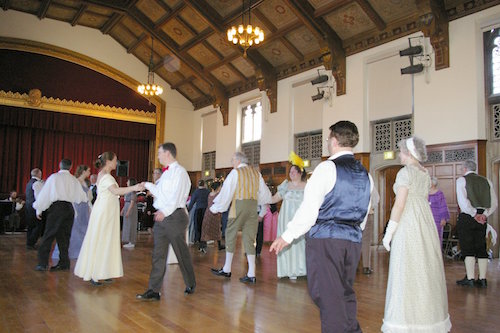
The First Jane Austen Ball Rochester, NY (photo credit Lisa Brown)

“…you shall if you please, name the very day of the ball.”
Pride and Prejudice ch. 9

Well, the day of the ball has been named. Your JASNA Central and Western NY Region and the Country Dancers of Rochester are sponsoring a Jane Austen Ball on April 24, 2016.  This will be an opportunity to dance like Jane Austen and her characters.

Ball Practice
“You’re getting six weeks’ notice on this, because these people are serious: You’ll need time to make or rent costumes, and practice…” said the Rochester Democrat and Chronicle (you will need to scroll down to the paragraph entitled Hitting the floor with The Physical Snob). Serious yes, but Jane Austen fans are also fun-loving and friendly. For those who are a bit rusty on “The Physical Snob,” ball practice lessons will be offered starting this Sunday, March 13, followed by a pot-luck supper. By the time the ball starts, you will be ready to lead off the dance like Fanny Price and Henry Crawford.

Caller
The ball will be led by Beverly Francis, an expert on Jane Austen. She has put together a program of period dances, and her knowledge of Jane Austen’s work and times will give a true Regency feel to the ball.

Music
The nationally known group Childgrove from Ann Arbor MI will provide music.  Childgrove has Debbie Jackson on piano, Anne Ogren on violin and viola, and Martha Stokely on oboe, pennywhistle, and recorder. Together these three have brought the music of Jane Austen’s time to people all over the country.

Venue
The ball will be held at the Memorial Art Gallery Ballroom in the old Cutler Union building. Built in 1933, Cutler Union was the original women’s dormitory for the University of Rochester. On the outside the building is in the neo-Gothic style (think Northanger Abbey), and inside it is pure elegance.

Memorial Art Gallery, Cutler Union Building
(https://en.wikipedia.org/wiki/Memorial_Art_Gallery)

So prepare to step into the pages of Pride and Prejudice. A full Jane Austen experience awaits you at the Jane Austen Ball. Full details of the event can be found at the website of the Country Dancers of Rochester: cdrochester.org.

Wednesday, February 10, 2016

Manners as Martial Arts: Jujitsu in the Drawing Room

Catherine Morland travels with John Thorpe, against her will. C.E. Brock

"I am glad of it; I will drive you out in mine every day."
"Thank you," said Catherine, in some distress, from a doubt of the propriety of accepting such an offer. 
Northanger Abbey Ch. 7.

Propriety was constantly on the minds of Jane Austen’s characters. Doing what was right was important in the acts of everyday life. In the quote at the beginning of this article Catherine Morland is worried about the propriety of riding alone in a carriage with John Thorpe. Of course, doing almost anything with John Thorpe would be inappropriate, but Catherine has not yet learned to navigate the shoal waters of propriety.

Later, Catherine goes with her brother and the Thorpes to visit Blaize castle, inadvertently standing up the Tilneys. On seeing the Tilneys, she realizes her blunder and begs Thorpe to stop, to no avail, as depicted by C. E. Brock. 

Aggrieved at the possible slight to the Tilneys, she attempts unsuccessfully to visit Miss Tilney.

“At the bottom of the street, however, she looked back again, and then, not at a window, but issuing from the door, she saw Miss Tilney herself. She was followed by a gentleman, whom Catherine believed to be her father, and they turned up towards Edgar's-buildings. Catherine, in deep mortification, proceeded on her way. She could almost be angry herself at such angry incivility; but she checked the resentful sensation; she remembered her own ignorance. She knew not how such an offence as hers might be classed by the laws of worldly politeness, to what a degree of unforgivingness it might with propriety lead, nor to what rigours of rudeness in return it might justly make her amenable.” Northanger Abbey, Ch. 12.

Somerset Buildings in Milsom Street, Bath. James Gandon, 18th century
http://art.bathnes.gov.uk/ow23/collections/images/2000.84-3193.JPG

Ignorance of the laws of etiquette could have serious consequences. Catherine has much to learn.

However, a thorough understanding of those same laws could be used to assert social standing or define relationships. Emma desperately hopes for an invitation from the Coles so she can have the opportunity of turning down the invitation in order to teach them a lesson.

“The Coles were very respectable in their way, but they ought to be taught that it was not for them to arrange the terms on which the superior families would visit them. This lesson, she very much feared, they would receive only from herself; she had little hope of Mr. Knightley, none of Mr. Weston.” Emma, Ch. 25

Caroline Bingley uses the occasion of a proper call to define her relationship (or lack thereof) with Jane Bennet. Jane reports on the visit in a letter to Elizabeth.

“Caroline did not return my visit till yesterday; and not a note, not a line, did I receive in the mean time. When she did come, it was very evident that she had no pleasure in it; she made a slight, formal, apology for not calling before, said not a word of wishing to see me again, and was in every respect so altered a creature, that when she went away I was perfectly resolved to continue the acquaintance no longer.” Pride and Prejudice, Ch. 26

So manners can be a trap for the unwary or a weapon in the hands of the skilled. At our next meeting of JASNA CWNY, Lynn Festa, JASNA’s Traveling Lecturer for the East, will tell us about the use of manners for both offense and defense. Her talk is titled Manners as Martial Art in Austen: Jujitsu in the Drawing Room. Here is the abstract:

“This paper examines manners as offensive weapon and as defensive shield, as smooth art and as hard labor, in Austen’s novels.  Austen was, of course, aware of the conduct book strictures that delineated ideal female comportment, and her novels show her characters both using and flouting the rules of propriety.  What is being attacked, and what is being defended, in these violations of decorum—in those moments where manners falter or are allowed to drop, in which Austen, her narrator, or her characters are not inadvertently but deliberately rude?”

Lynn Festa is associate professor of English at Rutgers University.  She is the author of Sentimental Figures of Empire in Eighteenth-Century Britain and France.  In addition to being the 2014 JASNA North American Scholar, Lynn has written on a wide range of topics including eighteenth-century wig-wearing, cosmetics as a sign of national difference, tales recounted by anthropomorphized things, the slave trade, the history of human rights, and Jane Austen.

Please join us for what promises to be a fascinating look at the use and abuse of manners in Jane Austen’s works. Be sure to review your conduct books before arriving.

See you there.

Event: JASNA CWNY February Meeting
Topic: Manners as Martial Arts in Austen: Jujitsu in the Drawing Room
             A talk by Lynn Festa, JASNA traveling lecturer for the East
When: Saturday, February 20, 2016 at 1 pm
Where: Barnes and Noble, Community Room, Pittsford NY