Wednesday, October 28, 2015

Exasperating Emma Binghamton Meeting


"EmmaTitlePage" by Jane Austen - Lilly Library, Indiana University. https://en.wikipedia.org/wiki/Emma_(novel)

It is such a happiness when good people get together--and they always do.Emma chapter 21. Spoken by one of the most exasperating characters in Emma.


Jane Austen’s Emma was published in 1816. As the title page attests, it was written by the author of Pride and Prejudice, but its main character, Emma Woodhouse, is not nearly as universally loved as the heroine of Pride and Prejudice, Elizabeth Bennet. Indeed, Emma is often considered as Jane Austen’s literary masterpiece, yet many people would rather read Pride and Prejudice. So how does the technically superior novel give way? Perhaps it is because, as Marie Sprayberry puts it, “its heroine, and many of her relatives and neighbors, are often thoroughly exasperating people?”

From the very beginning Emma and Elizabeth are presented differently. We first hear about Elizabeth from her father as “Lizzy has something more of quickness than her sisters.” (Pride and Prejudice chapter 1). Later, after she is insulted by Mr. Darcy at the Netherfield Ball, Lizzy reacts. “She told the story however with great spirit among her friends; for she had a lively, playful disposition, which delighted in any thing ridiculous.” (Pride and Prejudice chapter 3)

Lizzy is quick, spirited, lively, and playful.

"Come, Darcy," said he, "I must have you dance"
Spirited Lizzy Bennet deals with the proud Mr. Darcy. 
(C. E. Brock at http://www.mollands.net/etexts/prideandprejudice/pnpillus.html)

Then we read about Emma.

“Emma Woodhouse, handsome, clever, and rich, with a comfortable home and happy disposition,
… 
The real evils, indeed, of Emma's situation were the power of having rather too much her own way, and a disposition to think a little too well of herself; these were the disadvantages which threatened alloy to her many enjoyments.” (Emma chapter 1.)

Handsome, clever , and rich to be sure, but also a tad arrogant and spoiled. It’s downhill from there.

"I planned the match from that hour"
Emma matchmaking 
(C. E. Brock at http://www.mollands.net/etexts/emma/emmaillus.html)

Then there are Frank Churchill, Jane Fairfax, Mr. Woodhouse, and Miss Bates, all of them exasperating in some way. Frank is off to London for a haircut, Mr. Woodhouse wants everyone to eat thin gruel, Jane hardly speaks, and Miss Bates speaks far too much. Only the farmers, Mr. Knightly and Robert Martin, seem to make sense.

In the little village of Highbury, Jane Austen layers relationships on relationships; emotions and status mingle in a complex brew that leaves us wondering, as Marie Sprayberry puts it, “how can it all end happily?”.

Hypothetical map of Highbury by Penny Gay 
(http://www.jasna.org/info/maps.html)


A story of “three or four country families,” Emma challenges us to truly understand some of the basic truths about character and relationships that can leave us a little uncomfortable.

It’s all a great theme for discussion. Please join us in Binghamton as Marie Sprayberry leads a discussion of Emma: Exasperating Characters. Here are the details:

Event:   Emma: Exasperating Characters a meeting of the former JASNA Syracuse region
Where: RiverRead Books, 5 Court Street, Binghamton
When:  Saturday, November 7, at 2 pm

It will be a great warm up for next year’s AGM. Marie will also discuss our recent reorganization. Rest assured, you will only discuss and not meet any exasperating characters.

Tuesday, October 13, 2015

JASNA AGM - Return to the Regency


It is such a happiness when good people get together…Emma, chapter 21

Last weekend was JASNA’s Annual General Meeting in Louisville Kentucky and Jane Austen was correct in noting that when good people come together happiness follows. The weekend was full of creative company, intriguing insights, fabulous food, and merry music.

On Saturday we will all have the opportunity to savor the highlights of the weekend as we review the AGM at our JASNA CWNY meeting. Please join us at the Barnes and Noble in Pittsford at 1 pm. To tempt you, here are just a few of the things we considered:

How did a naval surgeon treat his patients?

 Royal Navy Surgeon

Surgeon's Instruments

How proficient was Mary Bennet at the pianoforte?

"Hammerflügel Conrad Graf rem" by Andreas Praefcke
https://commons.wikimedia.org/wiki/File:Hammerfl%C3%BCgel_Conrad_Graf_rem.jpg#/media/File:Hammerfl%C3%BCgel_Conrad_Graf_rem.jpg

Who was George Wickham? Impoverished soldier or master spy?

"Pride and Prejudice CH 15" by C. E. Brock
https://commons.wikimedia.org/wiki/File:PrideandPrejudiceCH15.jpg#/media/File:PrideandPrejudiceCH15.jpg

How did a Regency lady dress for visiting friends?

Regency Dress

How did a Regency lady travel?

Sedan Chair

How much would Darcy’s £10,000 per year be worth today?


What is an AGM really like?

 Salad to start dinner at the AGM


Belle of Louisville outside our hotel

Where is the best place to rent or buy Regency goods?


Why Regency Rentals and A Lady's Maid of course.

Hope to see you on Saturday.

Thursday, October 1, 2015

Dollars and Cents and Sensibility


Edward Austen Knight


…as a farmer,…, he had to tell what every field was to bear next year,….The plan of a drain, the change of a fence, the felling of a tree, and the destination of every acre for wheat, turnips, or spring corn, ..." Emma, chapter12

Generally, I don’t like to do book reviews. It is too much like homework, and, for me, the idea of reviewing a book detracts from the enjoyment of reading. However, I have just finished reading a book that deserves to be read by all those who are interested in Jane Austen’s life and times.

The book is Jane Austen, Edward Knight, & Chawton Commerce and Community by Linda Slothouber (1). This book is the result of work done by the author as  a participant in JASNA’s International Visitor’s Program. The purpose of that work and the book is to examine the finances of Edward Knight’s estate and use that information ”to provide a historical context for Jane Austen’s allusions to estate management in her novels, and to help those who study or visit the village of Chawton understand the estate economy there” (p. 2)

The book succeeds beautifully and provides a wonderful window into the lives of the landed gentry in Jane Austen’s time. Edward Knight was, of course, Jane Austen’s brother. He was adopted by wealthy relatives and became heir to a large estate primarily in Hampshire and Kent. He provided the home in Chawton where Jane Austen wrote Mansfield Park, Emma, and Persuasion, and where she, perhaps, put Pride and Prejudice and Sense and Sensibility into their final forms. Jane Austen is also known to have visited Edward at his main residence at Godmersham Park in Kent. As her wealthiest relative, Edward would have provided Jane Austen with a close example of the land owning class in Regency England.


Godmersham Park, Home of Edward Knight 
Attribution: David Anstiss)

The book focuses on the finances of Edward Knight’s estate, but opens with a description of Edward Knight himself and his inheritance. Suffice to say, he was more Knightly than Rushworth and he took a great interest in the management of his estate. 

The book then focuses on the details of the finances and management of the estate. While the estate records are often incomplete, some of the best documented years are from 1808 to 1819, spanning the time of Jane Austen’s residence at Chawton. During this time the property in Hampshire generated an average income of £4,278. Income from Edward Knight’s other properties probably added about £3,800, for a total income of about £8,000. Mrs. Bennet would have been impressed. However, Edward Knight needed to be a careful steward since his income varied significantly over this period. The postwar years were especially difficult, as the income form the Hampshire properties fell to £3,722 in 1815 from a high of £4,909 in 1813.


Chawton House, Edward Knight's Residence in Hampshire, now Chawton House Library

Of course, Edward Knight wasn’t the only one living on the estate. Linda Slothouber also introduces us to all the others who lived around Chawton: the magistrate, justice of the peace, steward, estate servants, genteel tenants, farmers, and day laborers. We learn about how they lived, how much they earned and what roles they all played in the working of the estate.

Slothuber focuses on the finances of estate management, but if you are not inclined toward numbers, never fear. Slothouber’s clear prose and accessible style work to bring these characters to life. By the time I finished reading the book, I felt as if I had been living at Chawton for a few days, getting to know the people who lived there. I would highly recommend this book for anyone interested in understanding Jane Austen’s world.

For me, the next step will be to open up a spreadsheet and start working with the numbers to better understand Regency economics.

1. Jane Austen, Edward Knight, & Chawton Commerce and Community, Linda Slothouber, Woodpigeon Publishing, woodpigeonpublishing.com 2015.

Thursday, September 17, 2015

Then vs. Now - JASNA CWNY meets in Syracuse


                         Canary Wharf is one of the biggest financial centres in Europe.


Steventon rectory, as depicted in A Memoir of Jane Austen

JASNA Central and Western New York will hold a Michaelmas meeting for Syracuse area members on Saturday, September 26 at 2 pm in the Sargent Room of the Liverpool Public Library 310 Tulip St. Liverpool NY,  13088.

In line with the theme of the JASNA AGM in Louisville, which is "Living in Jane Austen's World", this meeting will be about "Living in Jane Austen's World: Pros and Cons". As Marie Sprayberry asks, "What aspects of life in 1815 England would you prefer, and what would you rather stay in 2015 America for?

The meeting will also feature a book swap. If you can, please bring at least one book by/about JA or of possible interest to Janeites, and come prepared to take at least one book.

Let's get the discussion started. What do you like about Jane Austen's England?

Elegant estates?


A panoramic view of Chatsworth House and Park, early 18th century (Pieter Tillemans)

Beautiful balls?

Meryton Assembly Dancers (Lisa Brown)

Or maybe just the bonnets and cravats.

Pierre Seriziat in riding dress, 1795.


Barb's Bonnets on display at Country Dance Rochester's Netherfield Ball (Lisa Brown)


And what might you prefer from 2015?

Running water?

running water
Matthew Bowden www.digitallyrefreshing.com

Antibiotics?

Chemical Formula for Penicillin

Or beautiful balls?

Country Dance Rochester Turning of the Year Ball (Lisa Brown)

So, take your pick and please join us for a lively discussion of Then vs. Now.

Note from Marie: This year, September 26 will be the first day of the Liverpool Library’s “Down Under” book sale, to be held in the Library’s small underground garage. On the one hand, this may provide another incentive for book-loving Janeites to attend our meeting—but on the other hand, do allow some extra time to find on-street parking, since the garage will not be available and since the sale is likely to attract some extra traffic to the library.

Monday, September 14, 2015

Location, Location, Location


The Counties of England 

"And what is fifty miles of good road? Little more than half a day's journey.”
Pride and Prejudice ch. 32

From Devonshire east to Kent and from Hampshire north to Derbyshire, Jane Austen knew her way around England. Her novels span most of England. From seacoast and mountain, town to country, Jane Austen’s characters visited a wide variety of locales. 

But, of course, many of the main venues in Jane Austen’s novels are fictional. Part of Jane Austen’s genius was her ability to mix the real and imaginary in a way that makes the fictional locations seem so real. In Persuasion the scene moves from Uppercross (fictional) to Lyme (real) without missing a beat. With barely any description, Meryton and Highbury seem to be places we could visit on a day trip from London.

To make her places real Jane Austen provided all kinds of hints that her readers could use to imagine the settings. This is our own Carolyn Meisel’s topic for her JASNA AGM talk in Louisville this October. Her talk is titled “Locations for Jane’s Stories: Why were they chosen?  What clues did they give to her readers?  What have we missed?” and will be presented in Session B, Friday 3:50 pm.

But if you’re not going to AGM you can still hear Carolyn speak on this subject. JASNA CWNY is pleased to have Carolyn speak at our September meeting. She will preview her talk at AGM and give us insight into hints that distances, real locations ad old country names gave to Jane Austen’s readers. Using these clues Carolyn’s talk will give us a sharpened awareness of location in Jane Austen’s novels.

Join us on September 19th at 1 p.m. in the Barnes and Noble Pittsford store to find out where things really happened in Jane Austen’s novels.

As a bonus you might want to consider purchasing Edith Lank’s book Jane Austen Speaks to Women. There are only 54 copies left and Carolyn will be taking these to KY. So this may be your last chance. Copies are just $5 and will be available at Saturday’s meeting.

See you there.


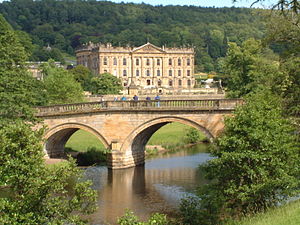
Pemberley?

(By Rob Bendall at https://en.wikipedia.org/wiki/Chatsworth_House)

Thursday, September 3, 2015

The Write Thing


“…his reading was capital, and her pleasure in good reading extreme.”
Mansfield Park ch. 34

Jane Austen well understood the power of reading aloud. Reading aloud was a favorite activity in her family. This year Medaille College is offering an exciting reading experience with an Austen connection. 

The Write Thing Reading Series begins on Tuesday, September 15 featuring Bella Poynton. Her science fiction play Speed Of Light can be seen in Buffalo at Road Less Traveled Theater from September 11-October 4. Readings from the play will be presented by the author and several actors. 

Jane Austen fans will especially appreciate the next two events in the series. Jack Wang, the co-creator of the Cozy Classics series of children’s board book series, headlines a reading on October 15. The Cozy Classics series includes Pride and Prejudice and Emma in its list of titles. Local JASNA members will remember that Jack spoke to our group about the production of Cozy Classics and won our hearts with the little felt figures.

http://www.mycozyclassics.com/books/ )

Next up is Amanda Jacobs on Thursday November 19. Amanda has always been a local favorite and now she is a national favorite with her work on Pride and Prejudice, A Musical. She has been a JASNA International visiting scholar. Last year she spoke to us about that project which was all about composing music for Jane Austen related prayers. The musical interludes left us wishing for more.

http://janeaustensprideandprejudiceamusical.com/ )

The reading program continues in the spring semester with the author Ted Pelton on Thursday February 25 and the poet Christopher Deweese on April 7. Finally, the program wraps up on April 28 with an open mic event. So sharpen your pencils and prepare to step up to the mic and read.

The Write Thing Reading Series promises to be a lively and engaging program. It’s free and open to the public. Events are on the 4th floor of the main building at Medaille College. Light refreshments will be served.

For more information and directions see the event website at :


This should definitely take some of the chill off the winter.


Thursday, August 27, 2015

Light, Bright and Sparkling


English Country Dancers sparkle at the Jane Austen Ball (author)

Just a quick reminder. If you would like to dance like Jane Austen, this weekend is your opportunity. Your JASNA CWNY and Country Dance Rochester are sponsoring a Netherfield Ball for novice dancers. There will be plenty of instruction, easy dances, delicious refreshments, and fine company. Now is the chance to relive some of the best moments from Jane Austen's novels.


The rocky coast of Maine sparkles in the morning sun (author)

The work is rather too light, and bright, and sparkling; it wants shade…or anything that would form a contrast, and bring the reader with increased delight to the playfulness and epigrammatism of the general style.” ( Jane Austen Letters http://www.pemberley.com/janeinfo/auslet22.html#letter125 )


As you may have guessed from the figure captions, the theme of this post is sparkle. The quote above  is probably the only thing Jane Austen wrote with which some of her readers might disagree. Pride and Prejudice is light, and bright, but it also engages real issues of, well, pride and prejudice.

As to sparkling, the novel sets the tone from the very beginning. Of all Jane Austen’s novels, Pride and Prejudice is the one that far and away begins with the most of Jane Austen’s bright, insightful, and witty dialog.

Here’s the beginning (as if I really need to quote it):

“It is a truth universally acknowledged, that a single man in possession of a good fortune must be in want of a wife.

However little known the feelings or views of such a man may be on his first entering a neighbourhood, this truth is so well fixed in the minds of the surrounding families, that he is considered as the rightful property of some one or other of their daughters.”

So much for historical background and moral philosophy. Jane Austen moves right into dialog.

“"My dear Mr. Bennet," said his lady to him one day, "have you heard that Netherfield Park is let at last?"

Mr. Bennet replied that he had not.

"But it is," returned she; "for Mrs. Long has just been here, and she told me all about it."

Mr. Bennet made no answer.

"Do not you want to know who has taken it?" cried his wife impatiently.

"You want to tell me, and I have no objection to hearing it."

This was invitation enough.”

Contrast this with the beginning of Sense and Sensibility:

“The family of Dashwood had long been settled in Sussex. Their estate was large, and their residence was at Norland Park, in the centre of their property, where, for many generations, they had lived in so respectable a manner as to engage the general good opinion of their surrounding acquaintance. The late owner of this estate was a single man, who lived to a very advanced age, and who for many years of his life, had a constant companion and housekeeper in his sister.”

The history of the Dashwood family goes on from there. Other than a few of John Dashwood’s thoughts there is no dialog. In Pride and Prejudice we learn about The Bennets though their dialog. Thanks to Mr. Bennet’s rather pointed sense of humor this is some of Jane Austen’s wittiest dialog. 

"My dear Mr. Bennet," replied his wife, "how can you be so tiresome! You must know that I am thinking of his marrying one of them."

"Is that his design in settling here?"

"Design! nonsense, how can you talk so! But it is very likely that he may fall in love with one of them, and therefore you must visit him as soon as he comes."

"I see no occasion for that. You and the girls may go, or you may send them by themselves, which perhaps will be still better; for, as you are as handsome as any of them, Mr. Bingley might like you the best of the party."

So we learn about Mrs. Bennet’ obsession with marriage and how sarcastic Mr. Bennet can be.

In Sense and Sensibility we get the John Dashwood's character in a narrative form.

“He was not an ill-disposed young man, unless to be rather cold hearted and rather selfish is to be ill-disposed: but he was, in general, well respected; for he conducted himself with propriety in the discharge of his ordinary duties. Had he married a more amiable woman, he might have been made still more respectable than he was:--he might even have been made amiable himself; for he was very young when he married, and very fond of his wife. But Mrs. John Dashwood was a strong caricature of himself;-- more narrow-minded and selfish.”

Of course we also learn about Elinor and Marianne.

“Elinor, this eldest daughter, … possessed a strength of understanding, and coolness of judgment, which qualified her, though only nineteen, to be the counsellor of her mother…”
Marianne's abilities were, in many respects, quite equal to Elinor's. She was sensible and clever; but eager in everything: her sorrows, her joys, could have no moderation. She was generous, amiable, interesting: she was everything but prudent.”

We learn about John, Elinor, and Marianne Dashwood through brilliantly composed, concise and sometimes devastating narrative rather than sparkling dialog. 

So Pride and Prejudice starts with light, bright dialog while Sense and Sensibility starts with a history lesson. Jane Austen’s other novels mix dialog and narrative in their first chapters (except Northanger Abbey), but none opens quite like Pride and Prejudice.

Jane Austen was a very talented and versatile writer. Her novels are unique and varied; each one is special in its own way. She may have thought Pride and Prejudice to be “too light and bright and sparkling” but she created it as such from the opening chapter and most readers would not have it any other way.